Bromo Ijen Tour From Bali
Bromo Ijen

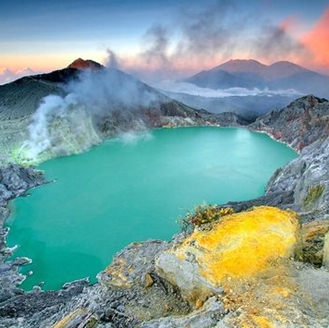
Ijen Crater is the most important crater lake in Java. The sulfur crater lake lies between an all-natural dams of deeply etched rock. It‘s 200 meters deep and contains about 36million cubic meters of steaming acid water, shrouded inside a smelling swirling sulfur cloud. Within the crater the various color and scale stones are found. Indeed the crater of Ijen is beautiful garden of stone also.
The view of sulfur miners who climb and go right all the way down to the crater is likewise amazing. A man puts about 10 kg of yellowish stone in to his basket, before he descends the mountain slope to sell his load, carrying a similar basket, going inside the same direction, digging a similar mineral. It‘s the natural picture that may be seen everyday.
Ijen Plateau lies inside the centre of Ijen-Merapi Malang Reserve, which extends over much from the mountainous region directly west of Banyuwangi and borders upon the Baluran National Park inside the northeast. As at Mt. Bromo, the caldera is best viewed coming from the air. Fortunately, almost all commercial flights operating between Denpasar – Surabaya, Yogyakarta or Jakarta usually fly, otherwise directly over, then close by Ijen plateau, in which the seemingly luminous blue/green crater lake forms an unmistakable landmark. It‘s beautiful scenery and located about 32 km towards the north west of Banyuwangi.
The principal attraction at Ijen is that the large Crater Lake which has much sulfur, which lies hidden between sheer walls of deeply furrowed rock at greater than 200 meters. The Ijen crater itself lies at approximately 2, 300 meters above sea level. It forms a twin volcano using the now extinct Mount Merapi. The enormous Crater Lake, and that is 200 meters deep and covers an area of greater than meters, millions of square meters, contains about 36 million cubic meters of steaming, acid water.
Ijen crater shows a special kinds of volcanic feature common to Indonesia, about 1 kilometer in diameter and 175 meters deep. The ground is covered completely using a warm lake, milky blue green in colours held back using a dam built many years back from the Dutch, in an effort to keep your hot, mineral laden water from raining the crop lands below.
The crater could be reached from either the east as well as west by any sorts of vehicles, but the next section of the trip covers distance 3 km on foot (jungle track). However, the latter is much more popular approach, because the climb coming from the road’s end towards the edge from the lake is merely one 5 hours. And also a walk all around the lake takes a full day.
The temperature drops through the night, close to the crater rim it may fall to about 5° Celsius. An open road ends at Jampit, where very basic shelter is available. Additionally it is possible to rest inside the old vulcanology station further in the hill, now utilized by sulfur collectors, but permission should be obtained beforehand.
The sulfur is transported entirely on foot. During the past, horses were used however they were found to become less practical upon the hazardous terrain. Today, the mine yields nine to twelve plenty of sulfur daily.
Men carry individual loads of as much as 70 kg, often barefooted, as much as the rim of crater after which 17 km through mountainside to some factory near Banyuwangi. The porters are paid by weight. The foremost important advice if you‘re traveling to Ijen is

Komentar
Posting Komentar